Graham Smith
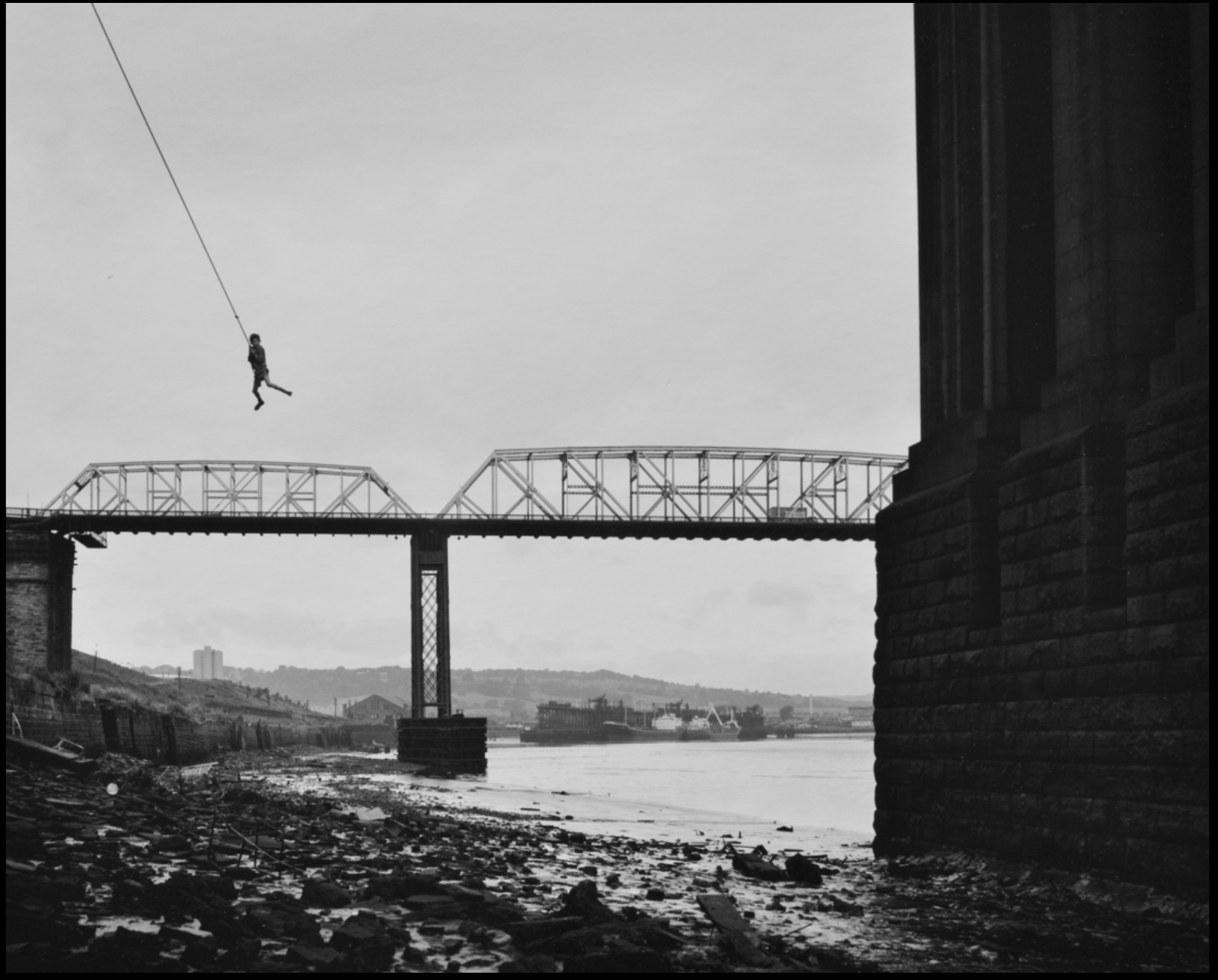
Tarzan Swing off the King Edward Railway Bridge, River Tyne, Gateshead Side, 1977
A boy launches himself from a railway bridge in County Durham, arms spread, body fully extended, silhouetted against the sky. The tide is out. Below him: mud, rocks, the River Tyne's exposed bed. There's a fine line between bravery and stupidity, and whichever this is has happened in spectacular fashion somewhere under a bridge built for trains, not flight.
The boy is airborne, superhuman, momentarily defying gravity and common sense. His body strains, every muscle engaged in the physics of not dying. This is the body as sculptural object: weight, momentum, risk made visible. At this moment he is king of his jungle, Tarzan swinging through industrial infrastructure repurposed as playground. The railway bridge wasn't built for this. It was built to move coal, steel, goods across the Tyne. But when industry recedes, what's left becomes something else.
Smith was documenting the industrial North in the 1970s, photographing landscapes dominated by infrastructure: railways, bridges, factories, terraced housing. But here he's caught something else: life being lived fast, carelessly, thrillingly in the gaps industry left behind. This is what happens when there's nothing else to do. The bridge becomes the entertainment. The river becomes the dare. Working-class kids making their own adrenaline in post-industrial spaces, transforming functional architecture into sites of risk and vitality.
The photograph elicits visceral response because the danger is real and immediate. The boy could die. The tide is out, which means rocks, which means impact, which means very serious injury or worse. But he's jumped anyway, committed fully to the arc, the flight, the moment of suspension between bridge and water. The risk is life-affirming precisely because it's terrifying. This is youth lived at a pace that can only be embraced by those who haven't yet learned to fear consequences, or who have nothing to lose by ignoring them.
The complexity of our response is dictated by our own neurosis and desire for self-preservation. We see the photograph and think: don't do that. But the boy has already done it. He's mid-flight, beyond intervention, fully committed. Smith has captured the exact instant between launch and landing, the body suspended in air, the risk made permanent. What survives is the evidence of the leap, the proof that someone jumped, the spectacular defiance frozen in time.
Graham Smith (b. 1947) is a British documentary photographer known for his work documenting the industrial North of England in the 1970s and 1980s.
