Mario Testino
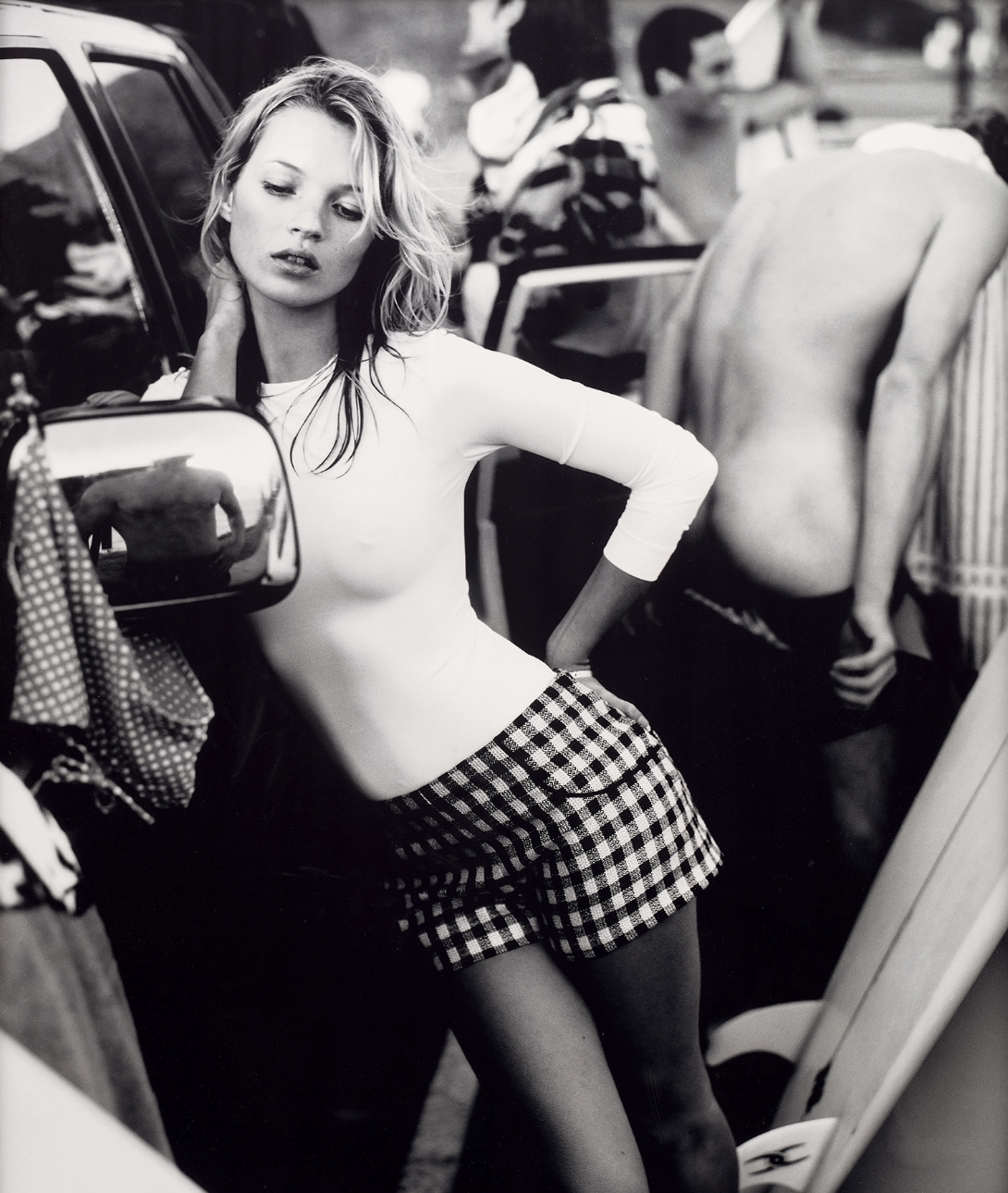
Kate Moss, LA, 1996
Mario Testino
Kate Moss is watching the surfer undress. Testino is watching her. This is the male gaze, under the auspices of fashion, watching the female gaze. It's a voyeur on a voyeur, layers of looking stacked in a frame.
This photograph was taken for a Harper's Bazaar editorial called "The Surf Report" in 1996. Moss wears $485 shorts and a $250 top. Short shorts were back in fashion. Testino said the shoot evoked memories of his time as a surfer in Lima, but nothing about this image is casual or remembered. It's constructed: luxury performing as spontaneity, fashion pretending to catch life unaware.
Three men occupy this frame. The surfer undressing, his bare muscular back hunched as he drops his shorts. Behind him, another man laughing, totally disengaged from what's happening in front. In the back of the mirror, a broad silhouette approaches. Moss seems unaware. None of these figures interact. Each watches or is watched, but no one connects. The photograph documents isolation performed as intimacy.
Moss creates a sculpture of herself. She leans to form a curve, elbow thrust out, hand touching her face. The white shirt cuts through the blurred background. Her eyes are cast downward to the mirror. You can't see them directly. She's absorbed in watching, but the watching itself becomes performance. Even her voyeurism is staged for Testino's camera.
The photograph is frozen, mute. There's no dynamism or movement despite the beach setting, despite the action of undressing. Fashion photography typically animates the body, suggests energy, sells aspiration. This does none of that. The figures are sculptural: the hunch, the touch, the twist in the body. Classical poses rendered in contemporary beach scene, vitality replaced by stillness. The surfer will drop his shorts but the moment never completes. Everything is suspended.
What Testino captures, perhaps unintentionally, is the loneliness of looking. Moss watches a man who doesn't know she's watching. Testino watches Moss watching. We watch all of them through the photograph. Each layer of observation isolates rather than connects. The mirror that should reflect reality instead reveals the apparatus: everyone performing for someone else, no one present for themselves. This is fashion's logic made visible. You don't wear clothes, you perform wearing them. You don't look, you perform looking. Even spontaneity requires choreography.
Mario Testino (1954-) is a Peruvian fashion photographer known for his work with Vogue, Vanity Fair, and numerous high-profile campaigns.
