RICHARD AVEDON
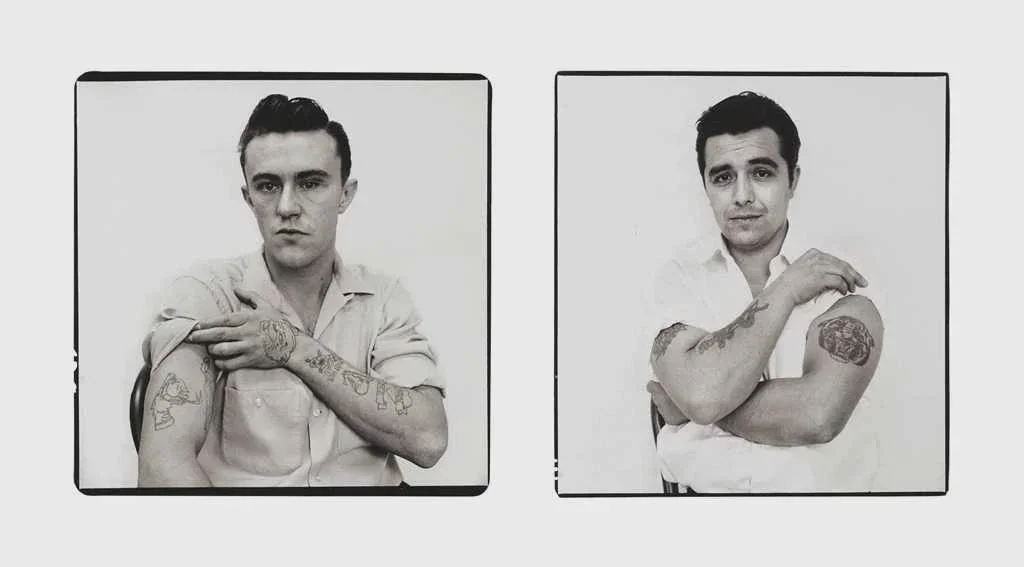
Richard Eugene "Dick" Hickock and Perry Edward Smith, 1960
In April 1960, at the request of Truman Capote, Richard Avedon travelled to Garden City, Kansas, to photograph two men awaiting trial for the murder of the Clutter family. Dick Hickock and Perry Smith had killed four people in a bungled robbery. Capote was following the case closely, and these portraits would eventually appear on the cover of In Cold Blood, published six years later.
Avedon's portraits operate as visual evidence, but evidence of what? Here's Capote on Hickock: "It was as though his head had been halved like an apple, then put together a fraction off center." Perry, by contrast, is described as having "dark, moist eyes", "pink lips and a perky nose", "a quality of roguish animation". The photographs confirm these descriptions with unsettling precision. Hickock's misaligned features, Perry's compact composure: both are there in Avedon's stark, white-background style. Once I had read Capote’s description of the men, and whenever he described something about their physical presence, I found myself flicking back to the cover to look them in the eye again.
But Capote's book was controversial for its questions of accuracy. The story is true only insofar as it is the subjective truth of the author. Avedon believed the same about his portraits. He said: "The moment an emotion or fact is transformed into a photograph it is no longer a fact but an opinion. There is no such thing as inaccuracy in a photograph."
In these portraits of two murderers, these worlds collide. The photographs don't document Hickock and Smith—they document how Capote saw them, how Avedon saw them, and how we, with In Cold Blood in our hands, are taught to see them. The white background eliminates context. What remains is subjective truth presented as objective record.
Richard Avedon (1923-2004) was one of the most influential photographers of the 20th century, known for his fashion work and stark, minimalist portraits. These photographs of Hickock and Smith were taken five years before their execution in 1965.
More on Avedon: The Richard Avedon Foundation | International Center of Photography
