MARK POWER
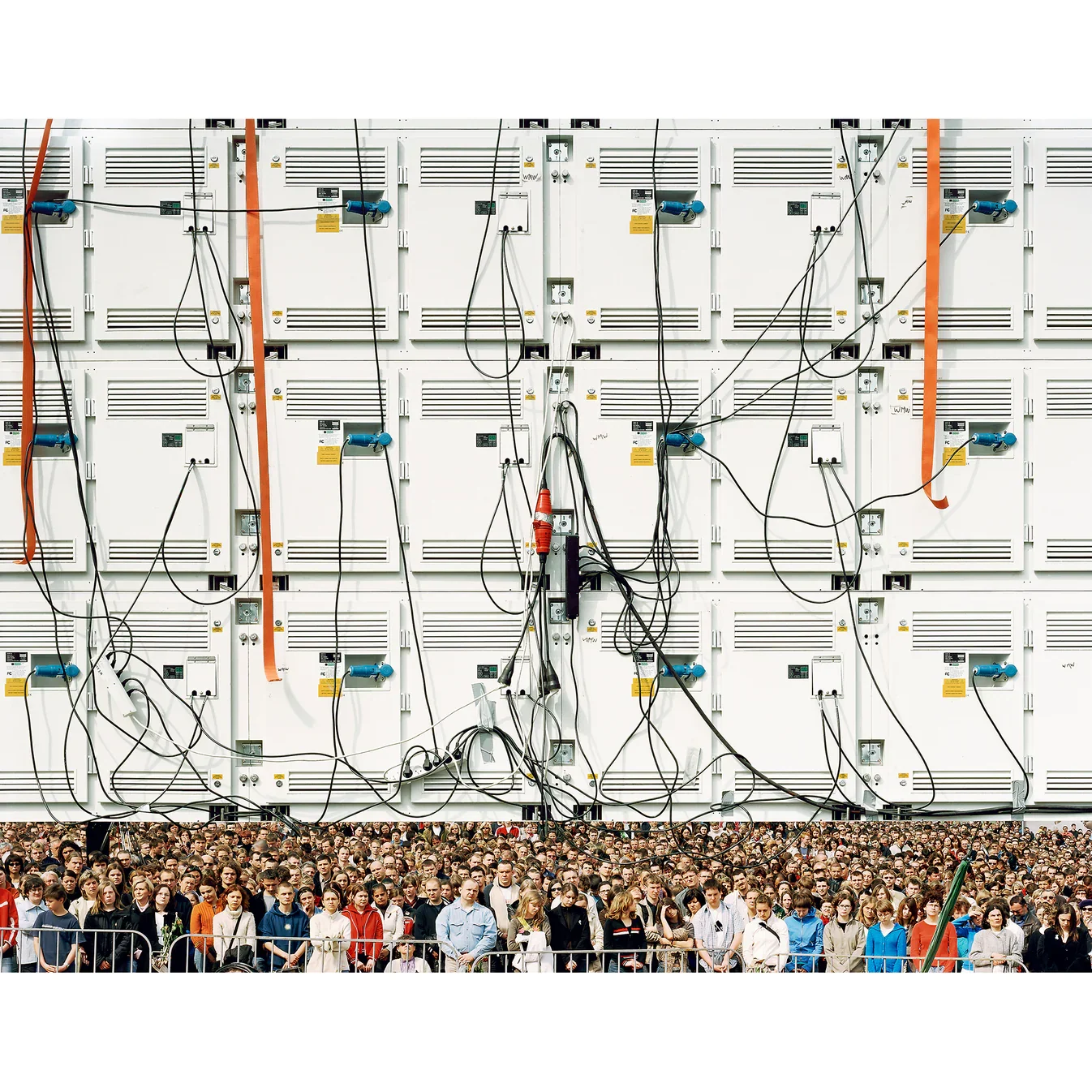
The Funeral of Pope John Paul II, April 2005
The backs of the screens fill most of the frame. White plastic casings, trailing wires, a rhythmic grid of monitors arranged in rows. Thousands of people have gathered in Poland to watch the Pope's funeral, and what Mark Power photographs is not the ceremony but its infrastructure: the apparatus of collective grief.
John Paul II was the first Polish pope. His death was felt acutely in Poland in ways it wasn't elsewhere. When he died in April 2005, thousands gathered in public squares not to attend the funeral but to watch it broadcast from Rome. They could have stayed home and watched alone, but they didn't. There's something about shared physical space, even when the experience is entirely mediated, that matters.
Power photographs this from behind. We see nothing of the ceremony itself, only the backs of the screens and the faces of those watching. The devotion is visible in their rapt attention, but the object of that devotion remains hidden. By excluding the broadcast image, Power forces us to look at how collective experience is constructed rather than what it contains. The screens become sculptural objects, geometric and uniform. Mass grief rendered as a grid.
This photograph is about what we usually ignore: the wires, the infrastructure, the mechanisms that make spectacle possible. Power's practice consistently examines systems and administrative spaces, the architecture of modern life that operates invisibly. Here, he makes the invisible central. The backs of the screens aren't incidental; they're the subject. This is what shared experience looks like from the other side.
The photograph also marks a specific technological moment, now outdated. This was April 2005, before smartphones turned every individual into their own broadcast unit. Collective viewing required communal screens. The experience was public by necessity, not choice. Within a few years, this configuration would become obsolete. People would raise phones instead, fragmenting the communal into thousands of private mediations.
But what Power captures isn't just technological infrastructure. It's the human need to be physically present for significant moments, even when presence means staring at a screen. The paradox holds: they gathered to watch something happening elsewhere, choosing collective mediation over solitary viewing. The backs of the monitors obstruct our view, but that obstruction is the point. We're looking at how we look, at the systems we build to share grief, at the distance between event and experience.
The Funeral of Pope John Paul II, April 2005 Copyright: © Mark Power / Magnum Photos
Mark Power (b. 1959) is a British photographer and member of Magnum Photos known for his long-term documentary projects examining infrastructure, systems, and the built environment. His work often focuses on spaces and structures that enable modern life but remain largely unnoticed.
More on Power: Magnum Photos | Brighton Photo Biennial
