DAVID MAYNE
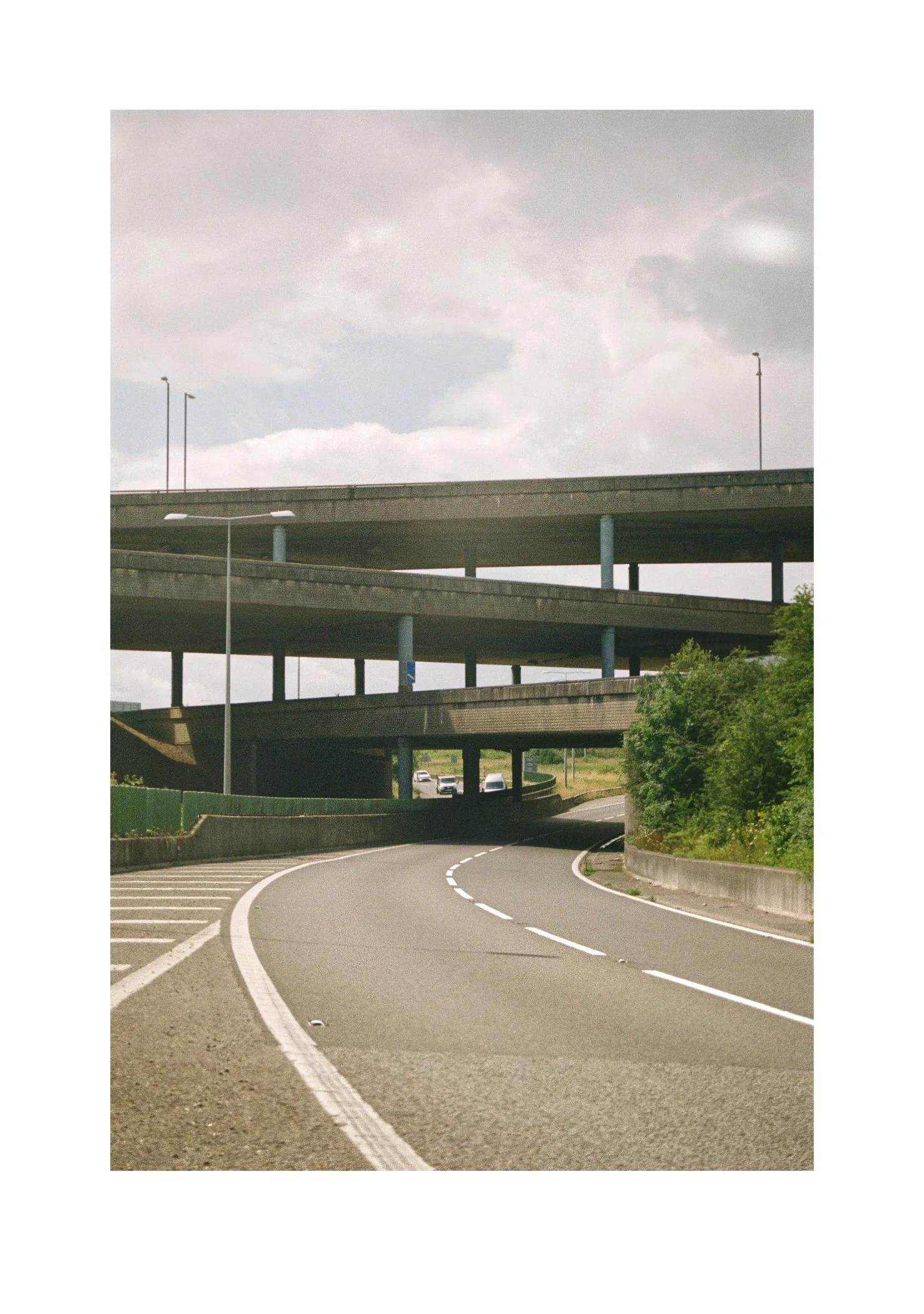
M4/M5 Interchange, near Bristol
Some places only exist at speed. The Almondsbury Interchange, where the M5 meets the M4 on the edge of Bristol, is one of them. This is the primary route into South Wales, a junction carrying thousands of vehicles daily, experienced as blur and momentum. David Mayne has frozen it.
Three road decks slash through the sky, concrete ribbons stacked with geometric precision. The scale is monumental: the heft of post-war civil engineering rendered as sculpture. But Mayne has emptied the frame of what gives motorways meaning. No cars, no movement, no sound. The roar and rumble of traffic is absent. Without speed, without direction, the interchange stops being infrastructure and becomes something else entirely: monument, ruin, architectural object.
Motorway interchanges are non-places, designed to be passed through rather than inhabited. You cannot stop on a motorway. You're not supposed to look. Photography makes that transgression possible. Mayne positions himself where no driver can, seeing what the design intends to make invisible. The junction exists to collapse distance, to make Wales reachable, to move goods and people with minimal friction. Mayne's photograph reverses this logic. It makes the motorway itself the destination.
Mayne's silence is deliberate. The (relative) absence of traffic renders the junction strange, defamiliarized. It could be abandoned. It could be ancient. The photograph holds the tension between what the structure is (functional engineering) and what it looks like (monumental architecture). The complexity and weight of the construction demand submission, but they also demand attention. We're meant to pass through without seeing. Mayne forces us to stop and look.
David Mayne's project YMA/Here (2016–ongoing) is an extended study of urban landscape photography across South Wales, the West Country, and beyond. The work examines structure, layout, and detail within the built environment, finding formal and conceptual depth in overlooked infrastructure.
