W Eugene Smith
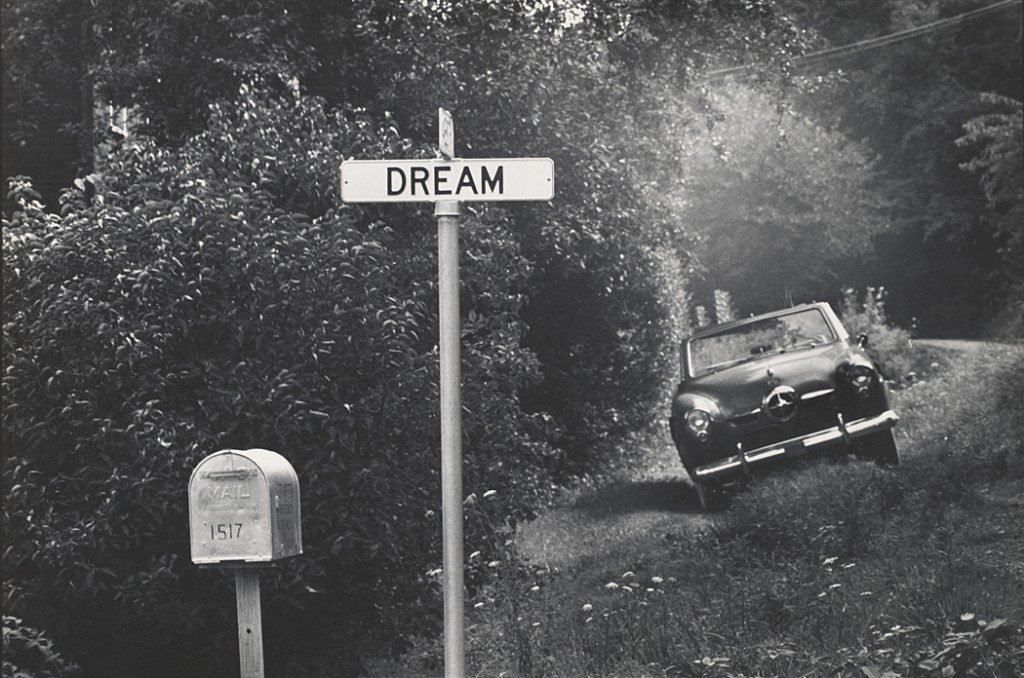
Dream Street, 1955
A street sign announces "Dream Street" against dense foliage. Street signs usually tell you where you are. This one tells you what to feel. Dream here. Dream now. The command is absurd and perfect: municipal infrastructure issuing an emotional directive, civic typography prescribing an interior state.
This is advertising logic applied to public space. In the 1950s, advertising was learning to sell aspiration rather than products, feelings rather than things. You didn't buy a car, you bought freedom. You didn't buy a house, you bought the American Dream. A street named Dream Street participates in that economy. You don't live on a street, you inhabit an emotional promise. The geography itself becomes branded experience.
But the photograph holds the gap between command and reality. The sign orders you to dream. The mailbox waits for correspondence, bills and letters arriving from the exterior world into private domestic space. The car sits stationary, parked, immobile despite representing mobility and escape. The vegetation presses in, lush and claustrophobic, enclosing everything. The scene is ordinary suburban prosperity, but the sign makes it strange by naming what's supposed to remain implicit. You're meant to dream here without being told to dream here. The instruction reveals the mechanism.
Smith came to Pittsburgh in 1955 for a three-week assignment and stayed nearly a year, producing over 13,000 negatives. He was obsessive, never satisfied, photographing the city with pathological attention. That this single street sign received that weight of scrutiny transforms it from municipal infrastructure into something else: evidence of how ideology operates at the most banal level, how emotional commands saturate even the smallest civic gestures.
The American Dream in 1955 was reaching its ideological height. Work hard, buy things, achieve security. Dream Street literalises that promise, makes it geographic. Live here and dream. But dreams commanded aren't dreams: they're instructions. The sign doesn't invite dreaming, it prescribes it. The difference is everything. The photograph captures that slippage: the moment civic space starts speaking in the language of advertising, when location becomes emotional directive, when you're told what to feel by the street you live on.
Image: W. Eugene Smith, Dream Street, 1955. Collection Center for Creative Photography, University of Arizona ©The Heirs of W. Eugene Smith
W. Eugene Smith (1918-1978) was an American photojournalist known for his uncompromising vision and obsessive working methods. His Pittsburgh project (1955-1956), originally commissioned for three weeks, consumed nearly a year and produced one of the most extensive photographic documents of a single city.
More on Smith: International Center of Photography | The Center for Creative Photography
