Tish Murtha
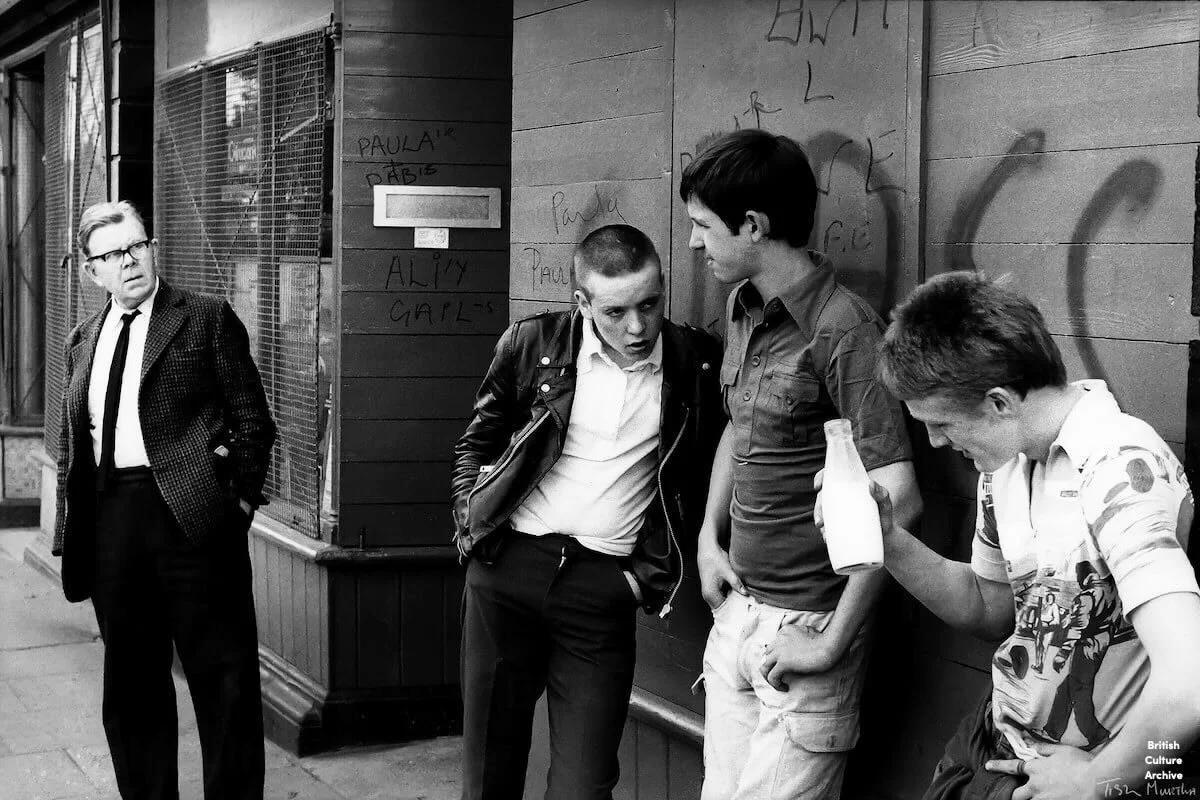
Kids at Elswick Road Post Office. From the series Youth Unemployment (1981)
Three boys face a man in a suit. The space between them is maybe three feet, but it might as well be a chasm. His hands are in his pockets. Their hands are in their pockets or on their hips. Everyone is closed, defensive, waiting. Behind them, shop fronts are grilled and boarded. Graffiti covers the walls: names of lovers scrawled in defiant permanence.
This photograph was taken in Elswick, Newcastle, in 1981. Tish Murtha was documenting her own community, photographing from inside rather than observing from outside. Elswick was working-class, built on shipbuilding and heavy industry, both decimated by Thatcher's government. By 1981, youth unemployment in the North East was catastrophic. These boys had no work, no prospects, no future being offered. The street became the only space they could occupy.
The man's expression is hard to read: frown, disdain, alarm, or recognition? The assumption is easy—older generation, suited, employed, judging feckless youth. But the suit could be respectability maintained against economic ruin, the last defence against being reduced to what Thatcherism called you if you were poor and Northern: undeserving. He may have shaped this world or he may be drowning in it too. Either way, the boys inherit the wreckage.
The boy in the middle drinks from a bottle of milk. Thatcher earned the nickname "milk snatcher" in 1971 when, as Education Secretary, she ended free school milk for children over seven. By 1981, that policy had become symbolic of her contempt for working-class children. The detail won't stay neutral.
Behind the figures, graffiti declares love. Lovers' names claimed on public walls, insisting on existence when everything else has been taken. In a world of closed shops and no work, this is what endures: the need to mark your presence, to say you were here, that you mattered, that you loved someone. One generation calls it vandalism. Another calls it survival.
The body language tells the story the faces won't. Hands in pockets, weight shifted, shoulders set. These are bodies with nothing to do. Unemployment makes bodies redundant, and the photograph captures that redundancy as posture. There's no aggression here, no threat. Just endurance. They're occupying space because there's nowhere else to be.
Murtha photographs the encounter without judgment, but the composition holds the tension. The suited man and the boys occupy the same frame, the same street, the same economic disaster. The grilled shops, the graffiti, the bodies in waiting: this is what Thatcherism looked like in Elswick in 1981. Not abstract policy but concrete experience. Not statistics but lives.
Tish Murtha (1956-2013) was a British documentary photographer from Elswick, Newcastle. Her Youth Unemployment series (1981) documented the devastating impact of Thatcherism on working-class communities in the North East, photographing her own neighbours and peers with unflinching intimacy.
More on Murtha: Tish Murtha Foundation | Amber Films
