Nick Treharne
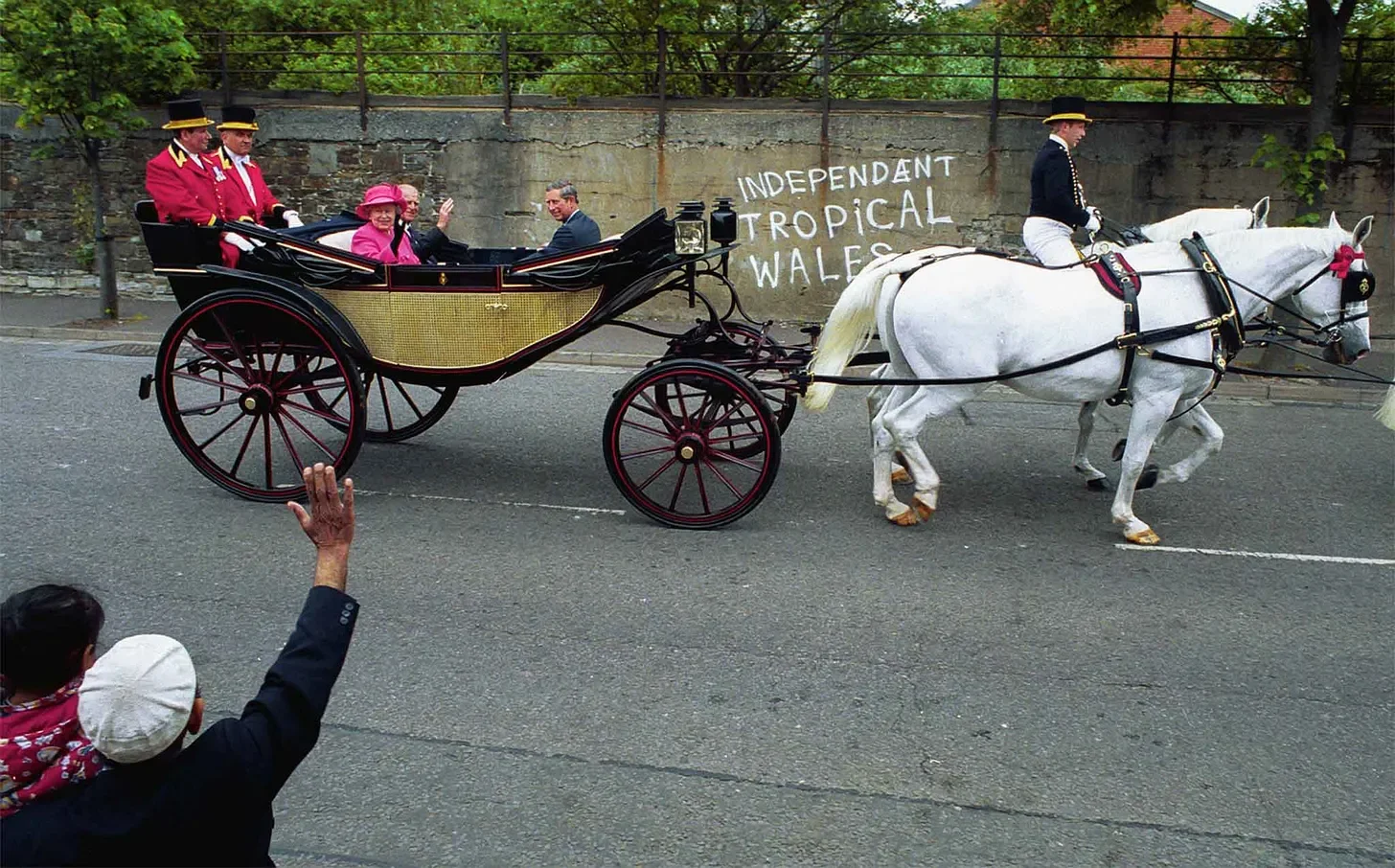
Independænt Tropical Wales, 1999
It's 1999. Wales, on its second attempt by democratic means, has achieved some measure of self-governance. The first referendum in 1979 was crushed, 79.7% voting against devolution. The second, in 1997, passed by the narrowest margin: 50.3% to 49.7%. Now, the National Assembly for Wales will govern in limited ways, its powers tied to Westminster. Still, this symbolised progress, reflected the optimism in the country at the time, even if what was granted remained modest.
In accordance with the peculiar and archaic traditions of the UK, the National Assembly was opened by Queen Elizabeth II. She was accompanied by her husband, the Duke of Edinburgh, and her son and heir, Charles, then Prince of Wales, now King. Together they are rolling down Bute Street in Cardiff in a golden landau. The street was named after the Marquess of Bute, whose title was hereditary and who owned and developed much of Cardiff. Bute Street, which connects the city centre to Cardiff Bay, is a tough road, one of the most ethnically diverse and deprived parts of the city.
Let's play that back: The National Assembly of Wales is being opened by a monarch who attained her title by birthright, her son and heir, and her husband. They are travelling down a road named after a marquess who had inherited great swathes of South Wales and beyond. They are in a golden carriage pulled by two white horses, processing through one of Cardiff's poorest streets to open an assembly with limited powers, granted not taken.
What makes this picture sing, and highlights the absurdity and patronising nature of what we see, is entirely down to the foresight of the photographer. The graffiti behind the royals screams: "Independent Tropical Wales." A hasty correction fixes the original misspelling of "independent," the writer having modified the letters to create something resembling the ligature æ. It's not clear if this is a Situationist declaration of statehood, or a demand for something more than is being offered by those in the carriage, but the effort made to correct the spelling matters. The message had to be right.
Two surreal worlds collide to create something sublime. Two levels of existence denied to most people: hereditary monarchy in golden carriages, and tropical independence for Wales, both equally fantastical. The photograph captures the gap between what was granted and what might have been demanded. Independence can be granted in limited measure by those who hold power, or it can be taken. The graffiti, corrected and insistent, knows which it prefers.
Nick Treharne is a Welsh photographer whose work documents Welsh culture, politics, and social life.
