Iwan Baan
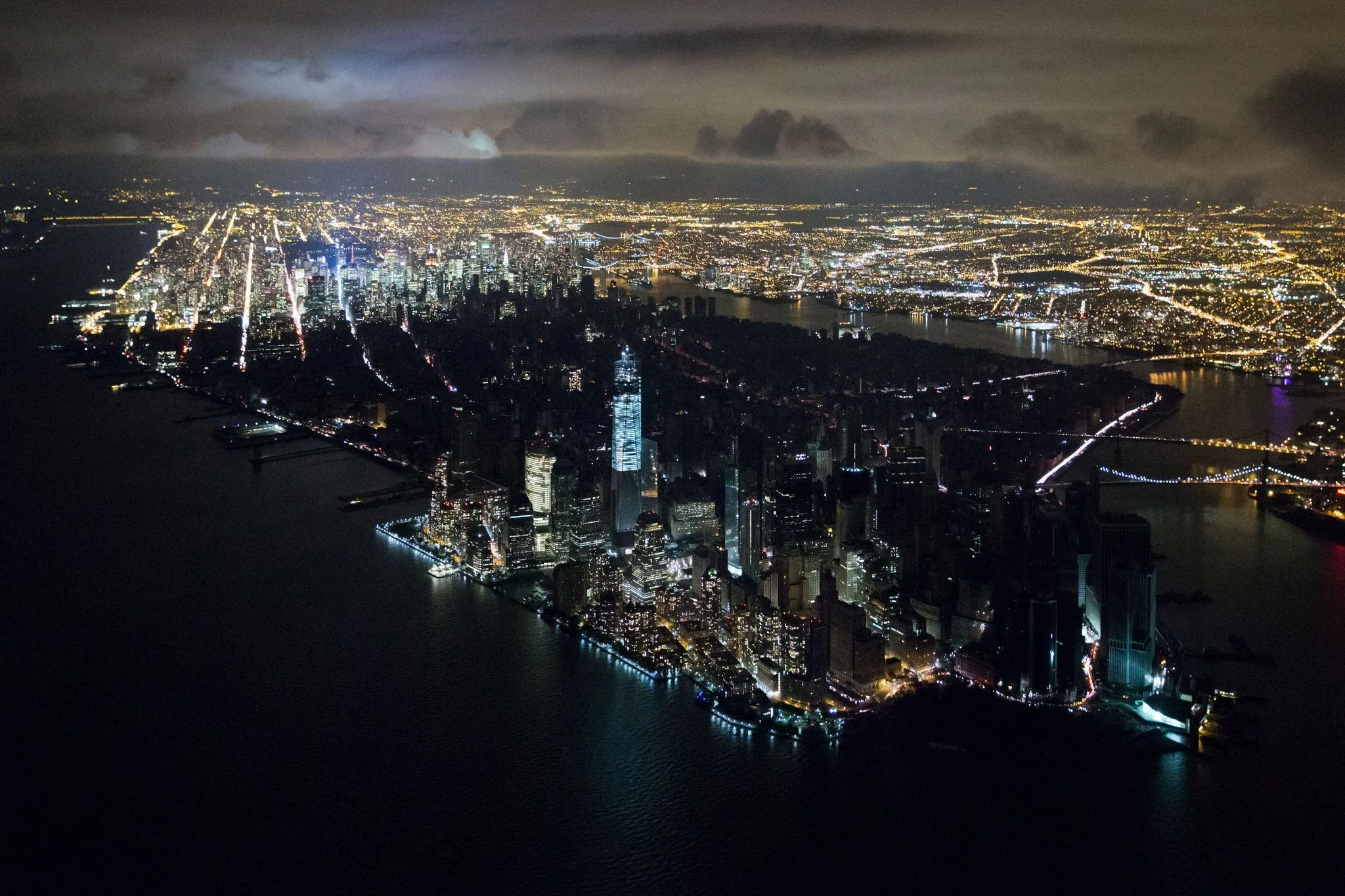
New York after Hurricane Sandy, 2012
So much that we rely on is invisible until it fails. When Hurricane Sandy made landfall on 28 October 2012, the storm surge flooded lower Manhattan and knocked out power south of 39th Street. The photograph shows the result: a hard line cutting across the city where electricity stops. Above the line, illumination. Below it, darkness. The grid is visible but half of it is dead.
Baan took this photograph from a helicopter the night after the storm. The aerial perspective makes the disaster legible, transforms chaos into composition. From the ground, Sandy was flooding, debris, panic. From above, it becomes geometric: the rational grid of Manhattan persisting even as its systems fail. The city's logic remains visible while its power disappears.
The line between light and dark isn't natural. It follows infrastructure, investment patterns, decisions about what gets restored first. Lower Manhattan includes the financial district, but also working-class neighbourhoods, public housing, waterfront communities. The photograph documents who has power and who waits. Infrastructure failure makes inequality visible.
This is New York, a city that sells itself as unstoppable, exceptional, immune to the forces that affect everywhere else. The mythology is relentless: film, photography, song, fiction all construct NYC as larger than life, perpetually ascending. The Manhattan skyline is perhaps the world's most iconic urban image, symbolising aspiration and permanence. Sandy punctured that mythology. The photograph shows the city vulnerable, subject to forces beyond its control, half-functional and half-broken.
Hurricane Sandy wasn't random weather. It was climate change made visible: rising sea levels, intensifying storms, predicted catastrophe arriving on schedule. Scientists had warned about New York's vulnerability to storm surge for years. The city was built assuming certain limits to what nature could do. Those limits no longer held. The photograph documents infrastructure designed for a climate that no longer exists, confronting a reality it wasn't built to withstand.
There's something cinematic about the image, disaster movie made real. The elevation, the stark division between zones, the way the city appears both magnificent and failed. But this isn't fiction. Over 40 people died. The subway system flooded. Thousands of homes were destroyed. The darkness in the photograph isn't aesthetic: it's people without heat, light, power, water, for days.
Baan's practice focuses on architecture, usually celebrating buildings and urban systems. Here, he photographs their failure. The buildings remain standing but they're powerless. Architecture without electricity is just material: glass, steel, concrete, inert. The photograph shows the city as object rather than system, beautiful and broken, the infrastructure that sustains urban life rendered suddenly, brutally visible through its absence.
Iwan Baan (b. 1975) is a Dutch photographer known for documenting architecture and urban environments. His aerial photograph of New York after Hurricane Sandy became one of the defining images of climate change's impact on American cities.
More on Baan: iwanbaan.com | MoMA Collection
Image credit: © Iwan Baan
